Two endpoints
The failure prefix anchors the recovery start; the success suffix specifies a state from which task execution can resume.
Large robot datasets contain abundant successful demonstrations and informative failures, yet they rarely show how to recover after a mistake. A failure marks a state in which a policy needs help; a successful demonstration reveals a state from which the task can continue. What is missing is the segment that connects the two, and collecting it is expensive, because each recovery has to be re-rolled from the exact state where things went wrong.
We propose Generative Bridging (GB), a framework that converts disconnected failure and success trajectories into synthetic recovery demonstrations. A vision-language model parses task stages and detects failure-induced regressions; a retrieval module proposes semantically valid and locally compatible success suffixes; a pretrained inverse dynamics model generates the missing recovery actions; and an action-conditioned world model reconstructs the intermediate observations required for frame-action policy training.
Our central hypothesis is that carefully filtered synthetic bridges can improve downstream recovery and task success without requiring exact reconstruction of each real-world scene in a simulator. The novelty is not endpoint interpolation alone, but a complete, uncertainty-aware framework for turning offline failures and successes into training data that teaches a robot how to get back on track.
This page reports early progress on the observation-completion component: a world model fine-tuned on RoboCasa regenerates a 71-frame recovery window from a single conditioning frame and an action sequence. The full pipeline and downstream policy evaluation are in progress.
The pipeline separates semantic decisions (when recovery is needed and where it should return) from generative decisions (how to move, and what observations the policy should see).
Semantic filtering removes impossible pairings before expensive generation; endpoint consistency filters the generated candidates afterward. Steps 5–6 are what the results below exercise.
Given offline failure and success trajectories for the same task family, we synthesize a valid recovery segment and use it as additional policy supervision. Each trajectory contains visual observations o, proprioceptive state q, and robot actions a.
Endpoint selection is a semantic problem before it is a generative one. Getting it wrong makes every downstream generation worthless.
The prefix is not the moment of error itself. It is the first stable state after a consequential failure, when a corrective policy could reasonably take control. For every short video window we predict a structured semantic state (task stage, target object, achieved relations, failure event, calibrated confidence), smooth those labels over time, and detect a drop from the highest reliably achieved stage.
Suffix selection is a constrained retrieval problem: first require semantic validity, then rank candidates by local compatibility and generative feasibility.
Key design rule. If the robot regresses from stage 3 to stage 1, the target should not merely be stage 2. It should restore the last reliably achieved state (stage 3 completed) or enter stage 4, reducing the chance of replaying the same failed transition.
A pretrained IDM supplies the actions; an action-conditioned world model supplies the observations an observation-conditioned policy needs.
The failure prefix anchors the recovery start; the success suffix specifies a state from which task execution can resume.
Produce a bounded sequence of up to roughly 96 action steps, allowing recoveries longer than a typical 32-action policy chunk.
Prefer endpoint agreement, smooth and bounded controls, collision-risk proxies, and model confidence over unfiltered synthetic scale.
The IDM gives actions but not the intermediate visual observations. For a policy predicting H actions from one frame (e.g. H = 32), the world model needs to supply only one conditioning frame per chunk, so generation can run at chunk boundaries rather than densely.
Interpretation boundary. Endpoint interpolation is not by itself proof of physical recoverability, and if the same world model both generates observations and ranks bridges, endpoint consistency may just reflect model bias. "Recovery" is claimed at the policy level; generated bridges are candidate supervision, filtered by consistency signals and calibrated against held-out real transitions.
One conditioning frame, then actions only. The model never sees another real frame.
To test the observation-completion component in isolation, we fine-tune Cosmos3-Nano into an action-conditioned forward-dynamics model on RoboCasa kitchen manipulation, jointly generating three camera views on a single canvas so the produced frames stay mutually consistent.
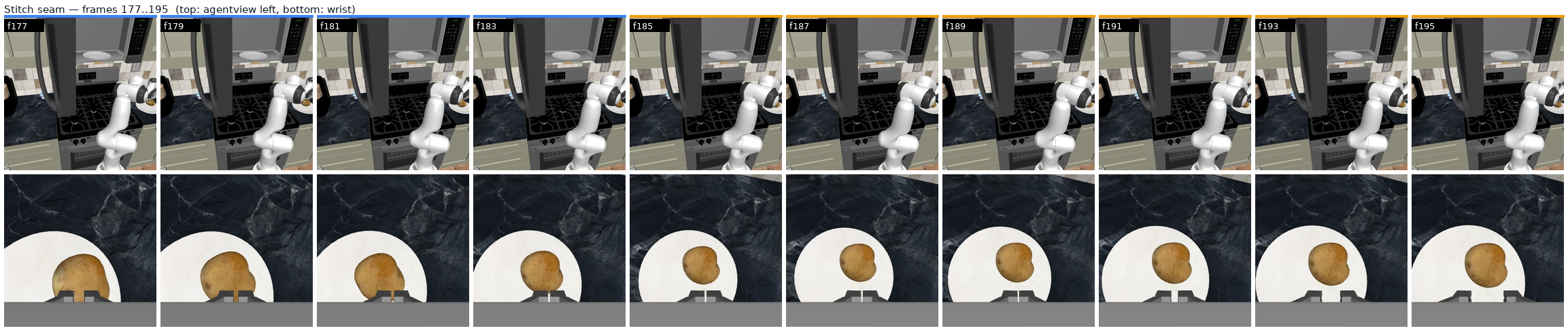
The episode below splices a failed rollout to a successful one at frame 185, a hand-constructed instance of the prefix/suffix pair the retrieval stage is meant to find automatically. We hand the model frame 184 alone, plus the 71 recorded actions of the recovery window, and let it generate the intervening frames as five chained 16-action chunks. Each chunk conditions on the last frame the previous chunk generated, so error accumulates with no ground-truth resets.
| Setting | PSNR (dB) | Frames above baseline |
|---|---|---|
| Repeat conditioning frame | 15.78 | n/a |
| Generated recovery (ours) | 20.79 | 71 / 71 |
Measured over the 71 recovery frames against the simulator rollout, on the three-view strip. Per-chunk PSNR: 21.34 · 20.73 · 21.73 · 20.64 · 17.85. Degradation is confined to the final chunk, consistent with autoregressive drift.
What this number is and is not. The failed rollout for this task is present in the world model's fine-tuning set, so the scene and its initial state are not unseen. The result should be read as action-following fidelity within a known scene, not as generalization to novel scenes, and not yet as evidence that the bridge is physically recoverable. A held-out evaluation is part of the ongoing work below.
Three views generated jointly, so the bridge is usable as multi-view training data.
The world model is trained in forward_dynamics mode: every action token is clean
conditioning and the loss is vision-only rectified flow. The three RoboCasa cameras (two
third-person agentviews and the wrist camera) are tiled into one 640×640 canvas so a single
generation pass keeps them geometrically consistent with each other, then sliced back apart
downstream. Actions are 7-D arm deltas re-encoded to a 10-D
[Δpos, rot6d, gripper] layout and quantile-normalized.
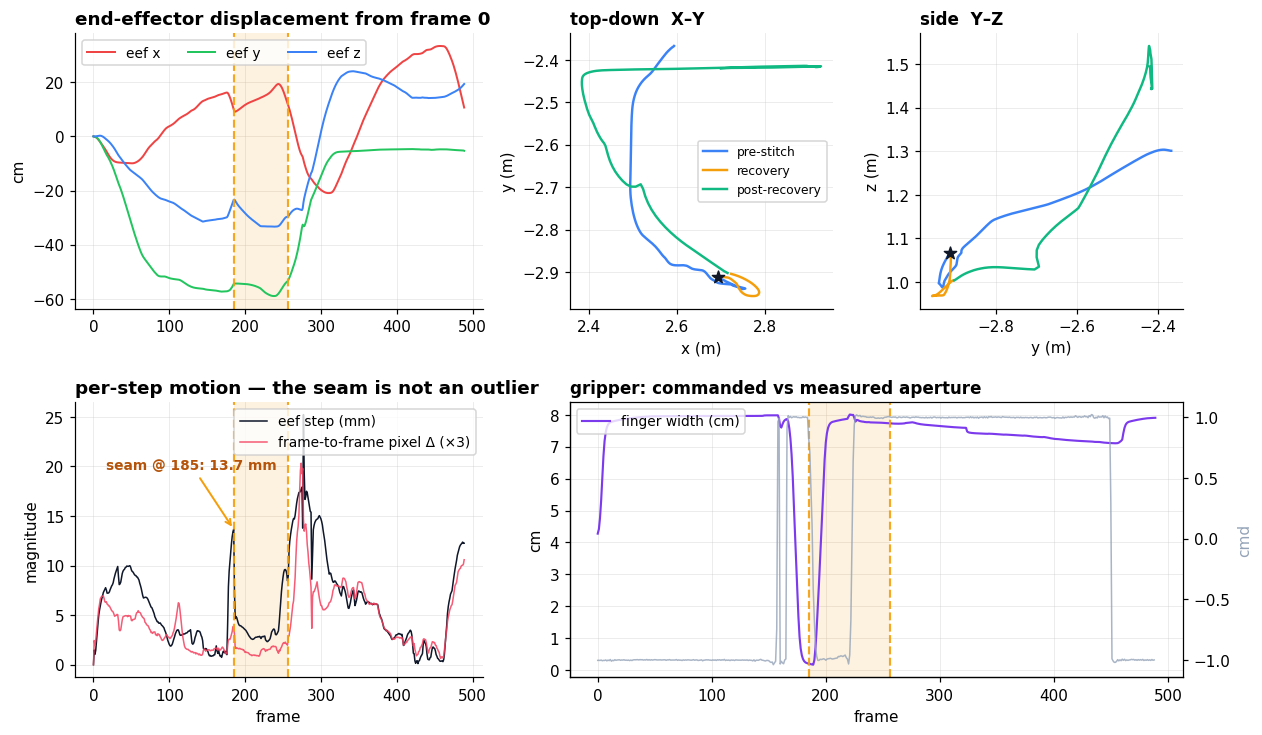
Train on real demonstrations and accepted synthetic bridges jointly, while explicitly accounting for synthetic-data uncertainty.
Begin with short, high-confidence bridges; introduce longer and more diverse recoveries after the policy learns stable local correction.
Tune real-to-synthetic sampling and cap repeated suffix patterns to avoid synthetic distribution dominance.
Down-weight uncertain VLM parses, large context mismatch, weak endpoint agreement, and high-action-cost bridges.
The primary claim is downstream policy improvement. Bridge-level metrics establish plausibility and diagnose failure modes, but do not replace real task evaluation.
| Study | Question | Primary metrics |
|---|---|---|
| Downstream policy | Does GB improve behavior after mistakes? Train identical policies with and without generated recovery data; evaluate on held-out scenes and induced perturbations. | Task success, post-failure recovery, interventions, time-to-recovery |
| Bridge consistency | Do generated actions approach the selected suffix? World-model endpoint comparison, proprioceptive agreement, action-limit and smoothness checks. | Endpoint distance, control cost, rejection rate |
| Controlled execution | Are bridges executable when full state is available? Run the pipeline on native simulation tasks where scenes and contacts are known, not as exact replay of real scenes. | Execution success, collision rate, horizon error |
| Human audit | Do samples look semantically and physically plausible? Blind comparison of random, retrieved, and GB-filtered trajectory clips. | Preference, plausibility, target correctness |
Does semantic stage reasoning select better recovery start and target states than scalar progress or visual nearest neighbors?
Does Generative Bridging improve downstream task success specifically after perturbations and naturally occurring failures?
Which filtering signals best predict useful synthetic data: local geometry, predicted horizon, endpoint agreement, or control cost?
Are world-model-generated observations necessary, and what temporal density is sufficient for action-chunk policies?
How does the quality-diversity tradeoff change as the synthetic-to-real training ratio and bridge horizon increase?
The proposal is strongest when it makes narrow, falsifiable claims: generated bridges are useful candidate supervision, not guaranteed real-world recovery trajectories.
This is an early-stage project page. The result above is a single-episode proof of concept for one component of the pipeline; the rest is planned work.
@misc{hyung2026bridging,
  title  = {Generative Failure-to-Success Bridging for Robot Learning},
  author = {Hyung, Junha and Jang, Hyojin and Choo, Jaegul},
  year   = {2026},
  note   = {Work in progress}
}